Big-capacity NAS HDD or premium NVMe SSD: which is the smarter buy?
These two drives solve very different storage problems, so the right choice depends on whether you need cheap, high-capacity bulk storage or fast, low-latency SSD performance. The Seagate IronWolf 4TB is a 3.5-inch CMR SATA hard drive aimed at NAS bays and RAID arrays, while the WD Red SN700 2TB is an NVMe M.2 SSD designed for intensive NAS cache and application workloads. They are not direct equivalents, but if you are choosing one drive for a home NAS, Plex server, or self-hosted setup, the differences in price, capacity, and speed matter a lot. The short version: one is built for storing more, the other for moving data much faster.
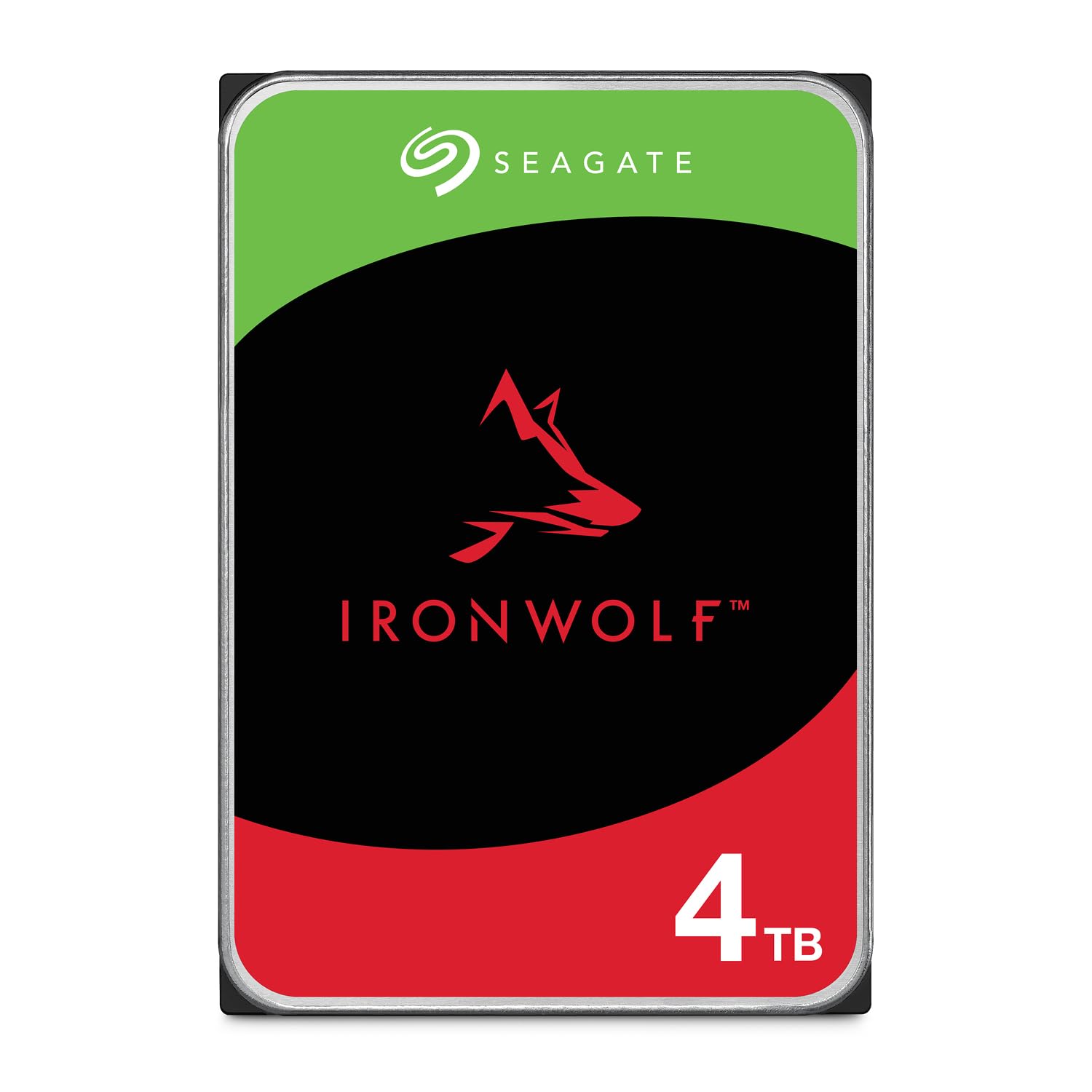
Seagate IronWolf 4TB, NAS, Internal Hard Drive, CMR, 3.5 Inch, SATA, 6GB/s, 5.400 RPM, 256MB Cache, for RAID Network Attached Storage, Data Rescue Services (ST4000VNZ06)

Our Recommendation
The Seagate IronWolf 4TB is the definitive winner for most buyers because it delivers 4TB of NAS-optimised CMR storage for £158.66, versus just 2TB at £482.74 for the WD Red SN700. If you are building a Plex box, backup NAS, or RAID array, the IronWolf gives you much better value and the right drive technology for sustained writes. The SN700 is faster, but its premium is only worthwhile if you specifically need NVMe SSD performance for cache or active workloads.
Detailed Comparison
Display
There is no display or screen quality to compare here, so this category is not applicable. For a storage purchase, the meaningful equivalent is how clearly each drive fits its intended role in a NAS. The Seagate IronWolf 4TB is a traditional 3.5-inch SATA hard disk made for always-on storage in multi-bay NAS units, while the WD Red SN700 2TB is an M.2 2280 NVMe SSD meant for high-speed flash storage. Winner: tie, because neither product has a display and each is designed for a different storage layer.
Performance
This is where the WD Red SN700 wins decisively. As an NVMe SSD, it offers far lower latency and much higher random IOPS than a 5,400 RPM hard drive, which makes it better for NAS cache, VM storage, Docker containers, database files, metadata, and general responsiveness. The Seagate IronWolf 4TB uses a 6Gb/s SATA interface and a 5,400 RPM spindle speed with 256MB cache, which is perfectly respectable for sequential transfers and media storage, but it cannot match SSD-level access times. In real home-lab terms, the IronWolf is ideal for large video files, backups, and archive data, while the SN700 is the better pick if your NAS is hosting lots of small files or latency-sensitive workloads. Winner: WD Red SN700.
Build quality and design
Both drives are built for NAS use, but they are engineered for different jobs. The IronWolf is a 3.5-inch CMR drive, which is important because CMR behaves better than SMR in RAID and sustained write workloads, especially when rebuilding arrays or running parity-heavy systems like TrueNAS, Unraid, or mdadm RAID. It also comes with Seagate’s Data Rescue Services, which adds a layer of recovery support that some buyers will value. The WD Red SN700, meanwhile, is a compact M.2 2280 NVMe drive with no moving parts, so it is inherently more resistant to shock and vibration and better suited to cramped systems with M.2 slots. If your NAS has multiple 3.5-inch bays and you want reliable bulk storage, the IronWolf’s form factor is the right design; if you need a cache drive or a fast internal SSD in a small footprint, the SN700 wins on modern design. Winner: tie, because both are well-built for their respective categories.
Battery life
Neither product has battery life, so this category does not apply. In practical home-server use, the equivalent concern is power draw and thermal behaviour. The 5,400 RPM IronWolf will generally consume more power than an SSD but remains efficient for a mechanical NAS drive, while the SN700’s flash-based design is typically better for low-latency, always-on caching workloads. Winner: WD Red SN700, if you interpret this as efficiency under load and idle responsiveness.
Price and value for money
The Seagate IronWolf 4TB is the clear value winner. At £158.66, it costs £324.08 less than the WD Red SN700 2TB, yet offers double the capacity and a purpose-built NAS HDD feature set. That means you are paying roughly £39.67 per TB for the IronWolf versus about £241.37 per TB for the SN700, which is an enormous gap. If your goal is simply to store more media, backups, surveillance footage, or general NAS data, the IronWolf gives far more usable space for the money. The SN700’s premium is only justified if you specifically need NVMe SSD speed for cache or active workloads. Winner: Seagate IronWolf 4TB.
Game library/features
For a NAS storage decision, “game library” is best interpreted as feature set and workload suitability. The IronWolf’s standout feature is NAS-friendly CMR recording, RAID compatibility, and the included data recovery service, which make it a safer choice for multi-drive arrays and long-term storage. The WD Red SN700’s feature set is all about performance: NVMe, M.2 2280, and SSD-level responsiveness for cache and application acceleration. If your NAS is serving Plex and backups, the IronWolf’s feature set is more broadly useful. If you are trying to speed up a ZFS special vdev, cache tier, or container volume, the SN700 is the more advanced tool. Winner: tie, because the better feature set depends entirely on the workload.
Overall user experience
For most buyers, the IronWolf 4TB delivers the more satisfying day-to-day NAS experience because it is easier to justify, easier to scale, and far less expensive per terabyte. In a typical UK home lab with a 2-bay, 4-bay, or 8-bay NAS, you can populate drive bays with IronWolf disks and immediately get dependable capacity for Plex libraries, Time Machine backups, photo archives, and RAID protection. The SN700 is a specialist drive: excellent if your NAS supports M.2 NVMe and you know exactly why you need it, but poor value if you are trying to build primary storage. If your machine has limited drive bays, plenty of RAM, and you are tuning for performance, the SN700 can make the system feel much snappier; otherwise, the IronWolf is the more sensible and less risky purchase.
Overall summary: the Seagate IronWolf 4TB is the better buy for most NAS owners because it offers far more capacity, lower cost, and proper CMR RAID-friendly behaviour. The WD Red SN700 2TB is faster and more specialised, but its price makes it a niche choice for cache or high-performance SSD workloads rather than general storage.
Buy the Seagate IronWolf 4TB, if...
Buy the Seagate IronWolf 4TB if you want primary NAS storage, media libraries, backups, or RAID array capacity. It is the better choice for 2-bay and 4-bay home NAS systems where cost per terabyte, CMR reliability, and predictable sustained writes matter most.
Buy the WD RED 2TB if...
Buy the WD Red SN700 2TB if your NAS has an M.2 NVMe slot and you need a fast cache drive, VM volume, or container/app storage. It makes sense when low latency and high random performance matter more than raw capacity, and you are happy paying a premium for speed.
Curated by Home Server Hub on All The Top Picks
As an Amazon Associate we earn from qualifying purchases.