Cheap 2TB or big 8TB NAS drive: which one actually wins?
If you’re building a NAS, Plex box, or backup server, these two drives sit at very different ends of the value spectrum. The Seagate IronWolf 2TB ST2000VNZ03 is a smaller-capacity, CMR NAS drive with a higher RPM and lower entry price, while the WD Red 8TB WD80EFAX offers far more raw storage for a much higher upfront cost. The right choice depends less on the badge on the label and more on how many bays you have, how you plan to use them, and whether you care more about speed, capacity, or total system cost.
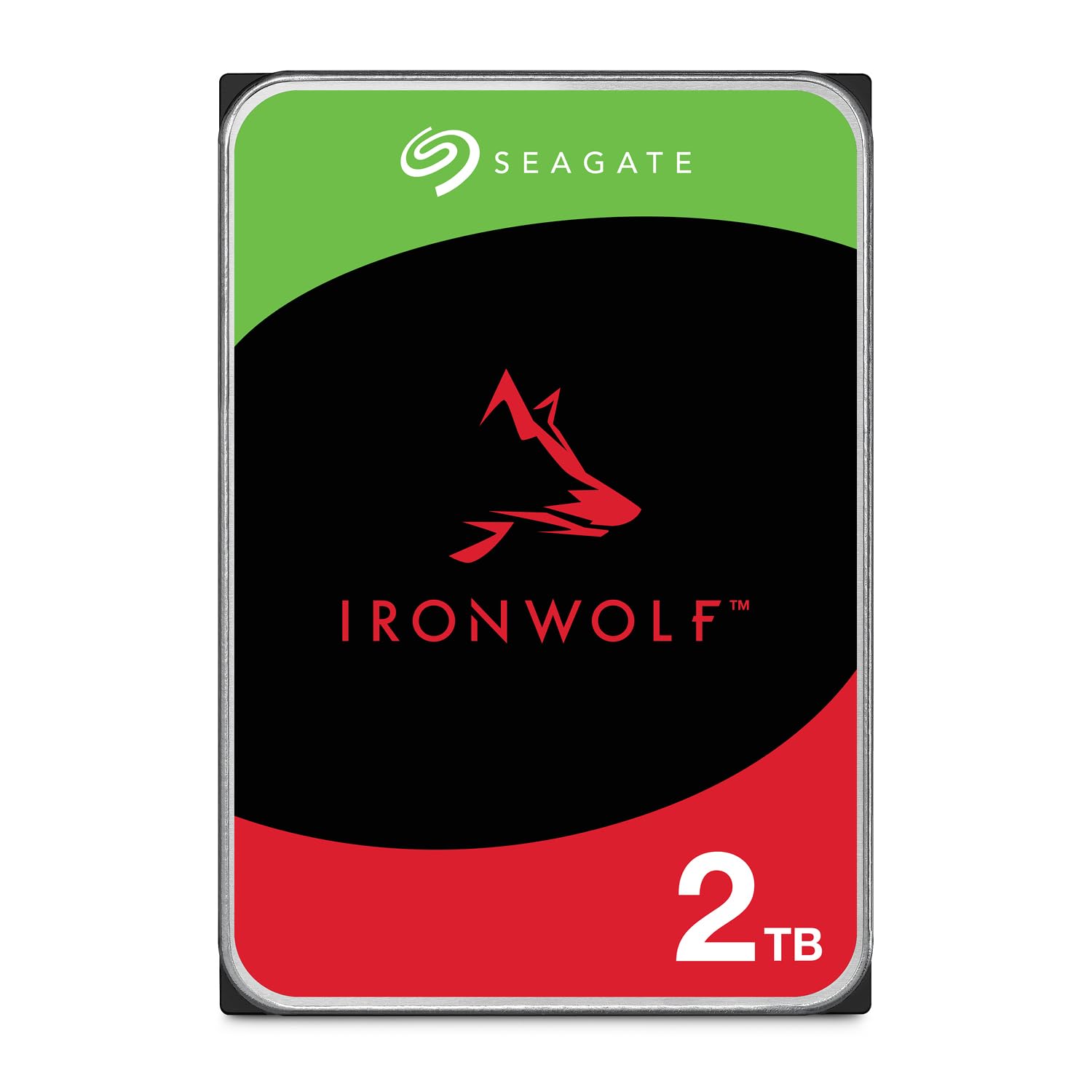
Seagate IronWolf 2TB, Enterprise Internal NAS HDD, CMR 3.5 Inch, SATA 6GB/s, 5900 RPM, 256MB Cache for RAID NAS, Data Rescue Services, Frustration Free Packaging (ST2000VNZ03)

WD Red 8TB 3.5 Inch NAS Internal Hard Drive - 5400 RPM - WD80EFAX
Our Recommendation
The WD Red 8TB is the definitive recommendation for most buyers because storage capacity is usually the limiting factor in a NAS, not spindle speed. At £343.94, it is expensive, but the jump to 8TB makes it far more practical for Plex libraries, backups, and RAID arrays than a 2TB drive. The Seagate IronWolf 2TB is faster on paper with 5900 RPM and 256MB cache, but its small capacity makes it poor value unless you have a very specific use case.
Detailed Comparison
Display
There is no display or screen on either product, so this category does not apply in the usual consumer-tech sense. For storage buyers, the more relevant equivalent is the drive’s specification sheet and how clearly it matches NAS use. On that front, Product A is the more straightforward NAS-focused option: it explicitly advertises CMR recording, 5900 RPM, 256MB cache, SATA 6Gb/s, and RAID/NAS positioning. Product B is also a NAS drive, but the listing is less detailed in the headline and its 5400 RPM class suggests a more capacity-oriented tuning. Winner: Product A, because its specs are clearer and more performance-oriented for NAS use.
Performance
For real-world NAS performance, the Seagate IronWolf 2TB has the edge in responsiveness. Its 5900 RPM spindle speed and 256MB cache should give it slightly better seek latency and snappier small-file handling than the WD Red 8TB at 5400 RPM, especially in a two-bay NAS, a Docker host, or a Plex metadata workload. That said, the WD Red 8TB will usually win on sustained sequential throughput simply because it has far more areal density; larger-capacity drives often read and write big media files more efficiently. In a RAID1 or mirrored setup, Product A may feel quicker for OS apps and light multitasking, but Product B is better if your workload is mostly large video files, backups, and bulk storage. Winner: tie, because Product A is faster in responsiveness while Product B is stronger for bulk transfer performance.
Build quality and design
Both are 3.5-inch internal NAS hard drives built for 24/7 operation, vibration tolerance, and RAID environments. Seagate’s IronWolf line is well known for NAS-specific tuning and often includes data recovery services, which adds a practical reliability perk if a drive fails outside normal warranty expectations. WD Red is also a long-standing NAS product family and is designed for low-noise, low-power operation in multi-bay enclosures. In terms of design philosophy, Product A leans toward performance and NAS resilience, while Product B leans toward quiet, efficient high-capacity storage. For a typical home NAS in a UK cupboard or utility room, the WD Red may run a little cooler and quieter, but the IronWolf’s more performance-focused spec sheet gives it the nod for mixed-use systems. Winner: Product A, narrowly, for its stronger NAS performance positioning and included data rescue services.
Battery life
Neither product has a battery, so this category does not apply directly. If you’re thinking in terms of power consumption, that’s where the WD Red 8TB can be attractive: lower-RPM NAS drives are often chosen for better efficiency and less heat, which matters in a 4-bay Synology, QNAP, or DIY TrueNAS box where drives run continuously. The Seagate may use a bit more power under load because of the faster spindle speed, though the difference at home is usually modest. If your NAS is on 24/7 and electricity costs matter, Product B may have a slight efficiency advantage. Winner: Product B, if you translate “battery life” into ongoing power efficiency.
Price and value for money
This is the clearest split in the comparison. Product A costs £128.00, while Product B costs £343.94, a difference of £215.94. On pure price per terabyte, the Seagate IronWolf 2TB is far more expensive per TB, which makes it poor value if you are buying storage capacity alone. The WD Red 8TB is also expensive in absolute terms, but you are getting four times the capacity, which is a much better proposition if your NAS is being used for media libraries, photo archives, VM backups, or surveillance footage. If you have empty drive bays and want the cheapest way to add usable space, Product B is the better value despite the higher sticker price. If you only need a small, fast, dependable NAS drive for a boot volume, mirror, or cache-related role, Product A is the cheaper purchase. Winner: Product B, because the 8TB capacity makes the cost easier to justify for most NAS buyers.
Game library/features
Neither hard drive affects a game library in the way a console or PC storage benchmark would, but they do affect how a media or app library behaves on a NAS. The Seagate IronWolf’s 5900 RPM and 256MB cache make it better suited to lots of small reads and writes, which is helpful for Plex metadata, Docker containers, and general home-lab services. The WD Red 8TB is the better choice for storing a larger library of films, TV shows, backups, and ISO files, where capacity matters more than access latency. If you’re running a Plex server on a small two-bay NAS and want the drive to feel responsive, Product A is more feature-aligned. If your “library” is really about storing as much as possible in one bay, Product B wins. Winner: tie, because the better choice depends entirely on whether you value responsiveness or capacity.
Overall user experience
In day-to-day use, the Seagate IronWolf 2TB will feel like the more nimble drive. It is the better fit for users who want a compact RAID mirror, a small NAS for documents and media, or a home server where speed and NAS-specific features matter more than sheer capacity. The WD Red 8TB is the more practical long-term storage buy for users with growing data needs, especially if you want fewer drives, less management overhead, and more room to expand before replacing hardware. In a 2-bay NAS, the 8TB drive can be transformative because it gives you meaningful usable space even after RAID1 mirroring. In a 4-bay or larger box, the 2TB drive starts to look cramped very quickly unless it is part of a tiered storage strategy. Overall summary: Product A is the better NAS drive on specs and responsiveness, but Product B is the better buy for most people because 8TB is vastly more usable and future-proof.
Overall verdict: if you need the best all-round NAS purchase, the WD Red 8TB is the more sensible choice thanks to its huge capacity and better value per terabyte. If you specifically want a smaller, faster-feeling NAS drive for a light-duty home server, the Seagate IronWolf 2TB is the sharper specialist option.
Buy the Seagate IronWolf 2TB, if...
Buy Product A if you want a smaller NAS drive for a mirror, a boot volume, or a light home-lab server where responsiveness matters more than storage space. It also makes sense if you are building a low-capacity RAID set and want a CMR NAS drive with decent specs at the lowest upfront cost. Choose it if your NAS has only one or two bays and you are not storing large media libraries. It is also the better fit for mixed workloads like Docker containers, metadata, and general file serving.
Buy the WD Red 8TB if...
Buy Product B if you want the most usable storage per drive and you expect your data to grow over time. It is the better choice for Plex libraries, backups, surveillance footage, and multi-bay NAS builds where capacity is king. It is also the smarter option if you want fewer drives to manage and a more future-proof setup. In a 2-bay NAS, 8TB gives you a much more realistic RAID1 usable capacity than 2TB.
Curated by Home Server Hub on All The Top Picks
As an Amazon Associate we earn from qualifying purchases.