IronWolf HDD or WD Red SN700 SSD: the real NAS storage decision
These two drives solve very different problems, even though both are marketed for NAS use. The Seagate IronWolf 2TB is a 3.5-inch CMR hard drive built for bulk storage, RAID arrays, and steady always-on use. The WD Red SN700 2TB is an NVMe M.2 SSD aimed at high-speed caching, VM workloads, and compact systems that support M.2 slots. If you are choosing storage for a NAS, Plex box, or homelab, the right answer depends less on brand and more on whether you need capacity-per-pound or raw I/O performance.
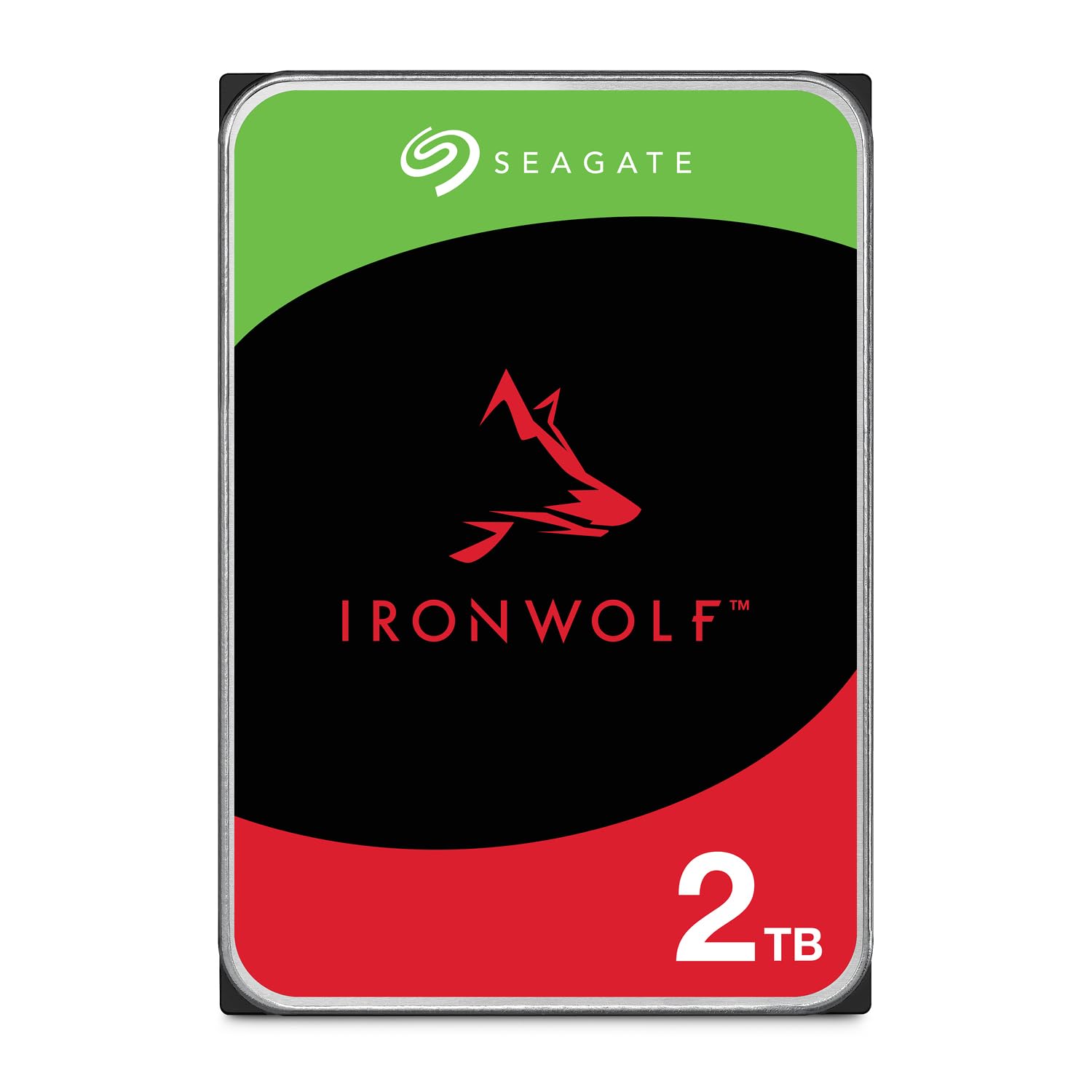
Seagate IronWolf 2TB, Enterprise Internal NAS HDD, CMR 3.5 Inch, SATA 6GB/s, 5900 RPM, 256MB Cache for RAID NAS, Data Rescue Services, Frustration Free Packaging (ST2000VNZ03)

Our Recommendation
The Seagate IronWolf 2TB is the better buy for most people because it offers true NAS-friendly CMR storage at £120, versus £324.86 for the WD Red SN700. It is far easier to justify in a 2-bay or 4-bay NAS, especially for RAID, Plex media, backups, and general file storage. The SN700 is faster, but its premium is enormous for the same 2TB capacity, so it only makes sense for specialised NVMe workloads.
Detailed Comparison
Display
This category does not apply in the usual sense because neither product has a display or screen. For a storage buyer, the closest equivalent is how clearly each drive fits its intended role. The Seagate IronWolf is a conventional 3.5-inch SATA HDD with 5900 RPM, 256MB cache, and CMR recording, which makes it easy to understand and deploy in standard NAS bays. The WD Red SN700 is an M.2 2280 NVMe SSD, which is more specialised and only works in systems with an M.2 slot or an NVMe-capable adapter. Winner: tie, because there is no display factor, but the IronWolf is simpler to integrate in typical NAS hardware.
Performance
The WD Red SN700 wins decisively on raw speed. As an NVMe SSD, it will deliver dramatically lower latency and much higher IOPS than a 5900 RPM hard drive, which matters for VM storage, Docker volumes, database workloads, and cache-heavy tasks. The IronWolf, by contrast, is built for sustained sequential throughput and multi-drive reliability rather than instant responsiveness; its 5900 RPM spindle speed and SATA 6Gb/s interface place it firmly in the HDD class. In a Plex server, the IronWolf is usually fast enough for media files, but if you are hosting virtual machines or a ZFS special vdev, the SN700 is in another league. Winner: WD Red SN700.
Build quality and design
Both are purpose-built NAS products, but they are designed for different environments. The IronWolf is a 3.5-inch enterprise-style NAS HDD with CMR recording, which is important because CMR behaves predictably in RAID and does not suffer the same write penalties as SMR drives. It also includes Seagate Data Rescue Services, which can be a useful safety net for home users. The SN700 is a compact M.2 2280 SSD, so it has no moving parts, no vibration, and a much smaller physical footprint. That makes it ideal for mini-ITX builds, NAS motherboards with M.2 slots, or systems where drive bay space is limited. For ruggedness and straightforward NAS compatibility, the IronWolf wins; for compactness and shock resistance, the SN700 wins. Overall winner: tie, because each is well designed for its own form factor.
Battery life
Neither product is battery-powered, so this category is not directly relevant. If interpreted as power efficiency, the SN700 SSD is the clear winner because NVMe flash storage typically uses less power at idle and avoids the mechanical overhead of spinning platters. The IronWolf HDD will consume more power and generate more heat, especially in multi-bay enclosures where several disks are spinning at once. In a UK home NAS running 24/7, that can affect electricity cost and cooling requirements over time. Winner: WD Red SN700.
Price and value for money
The Seagate IronWolf is the standout value here at £120.00, while the WD Red SN700 costs £324.86, a huge £204.86 premium. That price gap is difficult to justify if your goal is simply adding 2TB of reliable storage to a NAS. The IronWolf gives you the full 2TB of capacity in a format that works in almost any SATA bay, and it is backed by a very strong user base at 4.6/5 from 6,617 reviews. The SN700 also scores 4.6/5, but with 914 reviews, and its premium only makes sense if you specifically need SSD performance, low latency, or M.2-only deployment. For most buyers, the IronWolf is vastly better value. Winner: Seagate IronWolf.
Game library/features
This category does not apply to storage drives in the same way it would for a console or handheld. Translating it into features, the IronWolf offers practical NAS-focused extras: CMR recording, RAID-friendly behaviour, and Seagate Data Rescue Services. Those are meaningful features for a home server or small business NAS. The SN700’s key feature is speed, which is effectively a performance feature rather than a value-added NAS service. If your workload benefits from SSD features like low queue latency and high random read/write performance, the SN700 has the stronger technical feature set. If you want NAS-specific safety and compatibility, the IronWolf is better. Winner: tie, depending on whether you value NAS resilience or SSD responsiveness.
Overall user experience
For most people building a NAS, the IronWolf will deliver the better day-to-day experience because it is easy to deploy, broadly compatible, and much cheaper per drive. It is the sensible choice for bulk media storage, Time Machine backups, shared folders, and RAID arrays in a 2-bay, 4-bay, or larger NAS. The SN700 is a premium specialist drive that makes sense when you already have enough HDD capacity and want to accelerate metadata, databases, VMs, or cache on a system with M.2 support. In a typical home lab, the best setup is often not one or the other, but IronWolf for capacity and an SSD like the SN700 for cache or high-speed workloads. If forced to choose one drive for a general-purpose NAS, the IronWolf is the more practical and cost-effective option. Overall summary: the Seagate IronWolf wins for most NAS buyers, while the WD Red SN700 only wins if your workload is speed-first and your hardware supports NVMe.
Buy the Seagate IronWolf 2TB, if...
Buy Product A if you need affordable 2TB NAS storage for a Synology, QNAP, TrueNAS, or DIY SATA NAS with 3.5-inch bays. It is the stronger choice for RAID arrays, media libraries, and always-on storage where capacity and reliability matter more than speed. It is also the better pick if you want the lowest cost per usable terabyte.
Buy the WD RED 2TB if...
Buy Product B if your NAS or homelab has an M.2 NVMe slot and you specifically need very low latency and high random I/O. It is the right choice for VM storage, Docker app data, databases, or cache duties where an SSD will feel dramatically faster than a hard drive. Choose it only if the performance gain is worth the £204.86 premium.
Curated by Home Server Hub on All The Top Picks
As an Amazon Associate we earn from qualifying purchases.