Budget barebone nostalgia or modern powerhouse: which mini PC wins?
These two mini PCs sit at opposite ends of the market, so the right choice depends entirely on what you want to do. The Intel NUC6CAYH is a low-cost barebone kit built around an older Celeron J3455 platform, while the GEEKOM A6 is a modern, fully specced mini PC aimed at demanding productivity and media workloads. If you are comparing them for Plex, home lab use, office work, editing, or light gaming, the differences in CPU generation, memory, storage, and connectivity are huge. This comparison cuts through the spec sheet to show which one is actually worth buying.

Intel NUC6CAYH NUC Barebone Mini PC Kit with Intel Celeron J3455
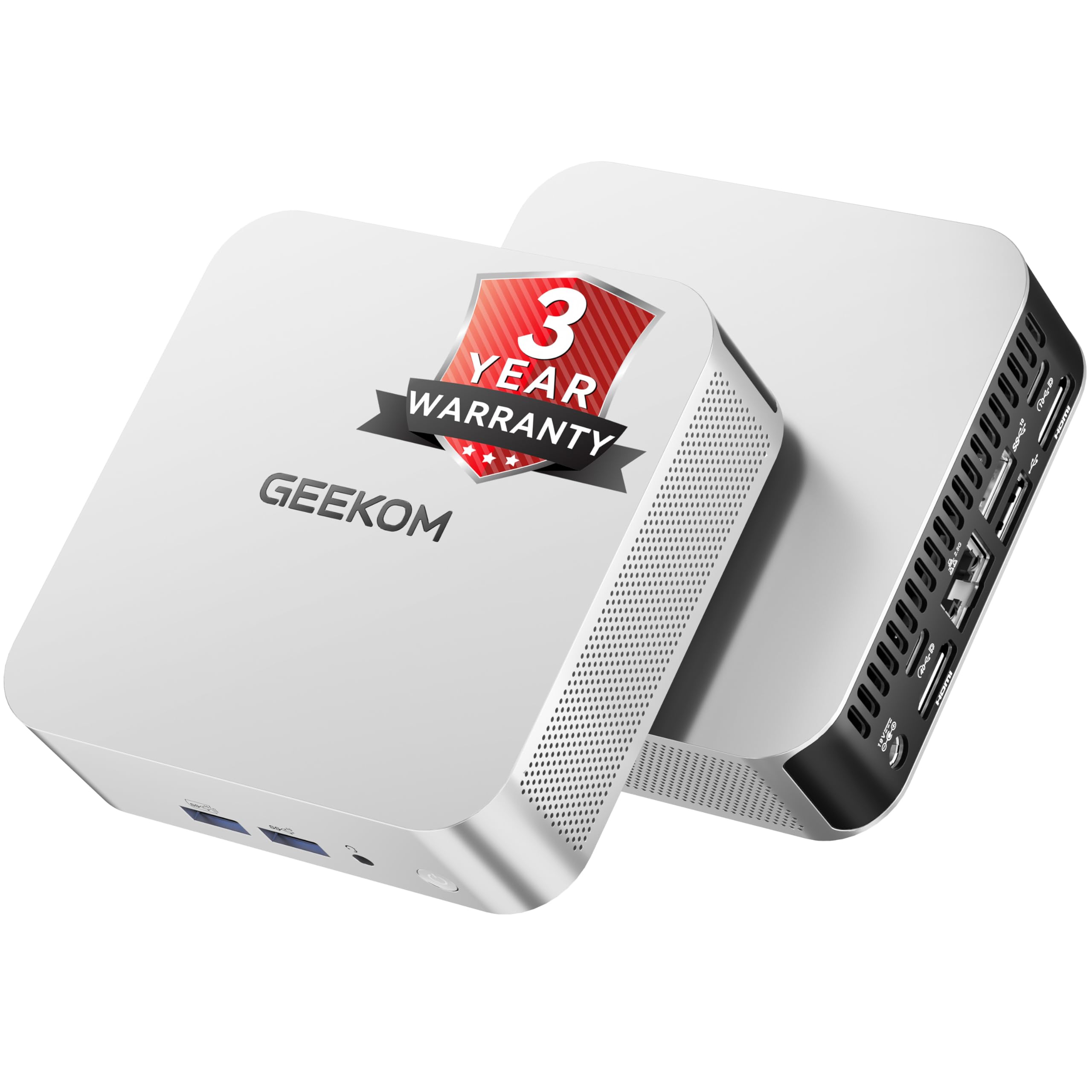
GEEKOM A6 Mini PC Windows 11 Pro, with AMD Ryzen 7 6800H (Beats 7640HS), 16GB High Speed DDR5 RAM (Up to 96GB) & 1TB SSD, Dual USB4.0 & Dual HDMI Quad Display for Video Editing/Gaming/Graphic Design
Our Recommendation
The GEEKOM A6 is the clear winner because it is in an entirely different performance class. Its Ryzen 7 6800H, 16GB DDR5 RAM, 1TB SSD, USB4, and quad-display support make it suitable for work, editing, and gaming, while the Intel NUC6CAYH is an older barebone Celeron system aimed at basic tasks. Yes, Product A is cheaper, but once you add RAM, storage, and software, the value gap narrows sharply. If you want a mini PC you can actually rely on for years, buy the GEEKOM A6.
Detailed Comparison
Display
Neither product includes a built-in display, so the real comparison is external monitor support and visual output capability. The Intel NUC6CAYH is limited by its older integrated graphics and older platform design, which is fine for basic 1080p office use and media playback but not ideal for multi-monitor or high-refresh workflows. The GEEKOM A6 wins clearly here because it offers Dual USB4.0 and Dual HDMI with quad-display support, making it far more flexible for a dual-monitor desk, a three-screen productivity setup, or a content creation station. Winner: Product B, because its modern display outputs are much better suited to current monitors and multi-screen setups.
Performance
This is not close. The Intel Celeron J3455 is a low-power quad-core chip from an older Apollo Lake generation, designed for simple tasks like web browsing, document editing, and light streaming. It is fine for a basic household PC or a simple NAS front-end, but it will feel slow with heavier browser workloads, large spreadsheets, multitasking, or any kind of editing. The GEEKOM A6 uses an AMD Ryzen 7 6800H, a high-performance 8-core, 16-thread processor with a much stronger integrated GPU and dramatically higher single-core and multi-core performance. That means faster app launches, smoother multitasking, better video export times, and a much better experience in creative software. Even the listed 16GB DDR5 RAM and 1TB SSD put it in a completely different class. Winner: Product B, by a very wide margin.
Build quality and design
The Intel NUC line has a strong reputation for compact, tidy engineering, and the NUC6CAYH barebone kit is no exception in terms of simple, functional design. However, it is an older product, and being a barebone kit means you still need to add storage and memory yourself, which adds time and cost. The GEEKOM A6 is the more polished product for most buyers because it arrives as a ready-to-use Windows 11 Pro mini PC with RAM and SSD already installed. It is also designed for broader modern use, with premium connectivity and a specification that better matches current expectations. If you value a clean out-of-the-box experience, Product B wins. If you specifically want a small, modular Intel platform to build up yourself, Product A has the classic NUC appeal, but it is still the weaker overall package. Winner: Product B.
Battery life
Neither of these is a battery-powered device, so this category is really about power efficiency and thermal behaviour. The Intel Celeron J3455 is very low power, so it will typically sip electricity and run quietly, which is useful for an always-on system, lightweight server, or basic media box. The Ryzen 7 6800H is much more powerful and will draw more power under load, but it is also a far more efficient modern chip per unit of performance. In practical terms, Product A wins on absolute low-power operation, but Product B wins on efficiency relative to the work it gets done. For most buyers, that makes Product B the more useful choice, especially if the machine will actually be doing real work rather than idling. Winner: Product A for lowest power use, but Product B for real-world efficiency.
Price and value for money
At £245.00, the Intel NUC6CAYH looks cheaper on paper, and the price gap is £247.15 versus the GEEKOM A6 at £492.15. But Product A is a barebone kit, so the sticker price does not include the full usable system: you still need RAM, storage, and likely a Windows licence if you want a standard desktop setup. Once you factor those in, the total cost rises quickly. Product B includes 16GB DDR5 RAM, a 1TB SSD, Windows 11 Pro, and a much faster platform, so the higher upfront cost is easier to justify. If you only need the cheapest possible Intel mini PC and already have spare parts, Product A can make sense. For most buyers, Product B offers far better value because it is effectively a complete modern computer rather than a project. Winner: Product B.
Game library/features
The Intel NUC6CAYH is not a gaming machine. Its Celeron J3455 and older integrated graphics are suitable for very light retro titles, cloud gaming, emulation at modest settings, and basic media duties, but modern games will be a struggle. The GEEKOM A6 is much stronger thanks to the Ryzen 7 6800H and its Radeon integrated graphics, which can handle a far wider range of PC games at sensible settings, especially esports titles and older AAA games. It is also better for features that matter to gamers and power users: USB4, dual HDMI, quad display support, and a much more capable CPU/GPU combination for launchers, mods, and background tasks. Winner: Product B, decisively.
Overall user experience
Product A is best understood as a budget barebone platform for very specific low-demand use cases. It can be a neat little box for a lightweight server, kiosk, or basic home office machine, but you need to build it out yourself and accept its age. Product B is the far more complete and satisfying experience: faster, quieter under normal use, ready to go out of the box, and strong enough for editing, gaming, and serious multitasking. For most people searching this comparison, the GEEKOM A6 is the better buy because it delivers a modern PC experience rather than a compromised legacy one. Overall summary: Product B wins because it is vastly faster, better equipped, and much more future-proof, while Product A only wins if your budget is tight and your needs are minimal.
Buy the Intel NUC6CAYH NUC if...
Buy Product A if you want the lowest upfront cost and already have compatible RAM and storage to reuse. It also makes sense if your use case is very light: basic web browsing, a simple always-on box, or a low-power experiment where performance is not important. Choose it only if you specifically want an Intel NUC barebone and are happy to build the system yourself. It is the more budget-conscious route, but only for users who understand the extra parts and limitations involved.
Buy the GEEKOM A6 Mini if...
Buy Product B if you want a complete mini PC that is ready to use immediately with Windows 11 Pro, 16GB RAM, and a 1TB SSD already included. It is the obvious choice for video editing, photo work, casual gaming, heavy multitasking, or a modern dual-monitor office setup. It is also the better option if you want USB4, dual HDMI, and room to upgrade to as much as 96GB RAM later. If you are buying once and want the stronger long-term machine, this is the one to get.
Curated by Home Server Hub on All The Top Picks
As an Amazon Associate we earn from qualifying purchases.