Budget starter or big-build beast? Ender 3 V3 SE vs Ender 5 Max
If you’re choosing between these two Creality machines, you’re really choosing between two very different kinds of 3D printing life. The Ender 3 V3 SE is a low-cost, beginner-friendly bed-slinger that gets you printing fast without wrecking your wallet. The Ender 5 Max is a much larger, more ambitious machine aimed at people who want serious build volume, higher-temp capability, and a more premium frame. Both have the same 4.4/5 rating, but the right pick depends almost entirely on what you want to print and how much you want to spend.

Creality Ender 3 V3 SE 3D Printer with 250mm/s Printing Speed CR Touch Strain Sensor for Auto Leveling Sprite Direct Extruder Dual Z-axis and Y-axis, 3D Printer for Beginner Print 8.6 * 8.6 * 9.8in
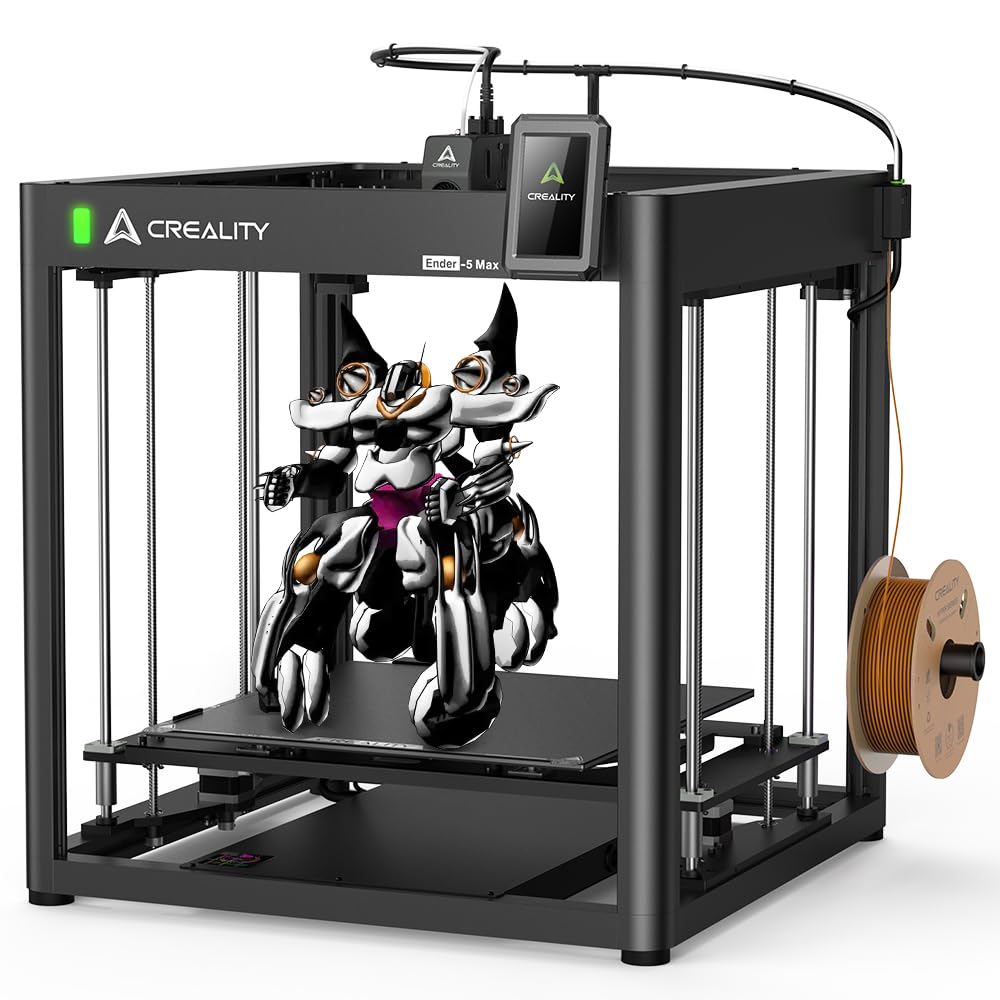
Creality Ender 5 Max 3D Printer, 700mm/s Max Printing Speed Large 3D Printer Build Volume 15.75x15.75x15.75 inch, Auto Leveling 300℃ High Temp Precise Linear Rail Dual Z Axis
Our Recommendation
Product A is the clear winner for most buyers because it delivers the best balance of features, ease of use, and price. At £169, it’s dramatically cheaper than Product B’s £895, yet still includes auto levelling, a Sprite direct extruder, and dual Z-axis support. Unless you specifically need the Ender 5 Max’s huge build volume and 300℃ capability, the V3 SE is the smarter purchase.
Detailed Comparison
Price and value for money
This is the biggest dividing line, and it’s not close. Product A costs £169, while Product B costs £895, a massive £726 difference. For most buyers, the Ender 3 V3 SE wins value for money by a mile because it gives you modern convenience features like auto levelling, a Sprite direct extruder, and dual Z-axis support at a very accessible price. The Ender 5 Max only makes sense if you genuinely need the larger format and higher-end motion system, because you are paying a premium that is more than five times the cost of the V3 SE.
Build volume and size
Product B wins here decisively. Its 15.75 x 15.75 x 15.75 inch build volume is huge compared with Product A’s 8.6 x 8.6 x 9.8 inch footprint. That means the Ender 5 Max can handle large cosplay parts, big functional enclosures, multiple smaller parts in one run, and fewer split-and-glue jobs. The Ender 3 V3 SE is absolutely fine for everyday prints, prototypes, brackets, miniatures, and hobby parts, but it will feel cramped if you regularly print large objects.
Performance and speed
On paper, Product B wins the speed race with a 700 mm/s max print speed versus Product A’s 250 mm/s. That said, in real-world printing, max speed numbers are often more marketing than everyday reality, and you usually won’t print most models anywhere near those limits without sacrificing quality. The Ender 3 V3 SE is the safer bet for consistent, beginner-friendly results because it is easier to tune and less demanding on the rest of your setup. The Ender 5 Max has the higher ceiling, but only experienced users or those printing well-optimised models will really exploit it.
Build quality and design
Product B wins on design and motion architecture. The Ender 5 Max’s larger frame, linear rails, dual Z-axis, and more substantial construction are better suited to stable large-format printing. That extra rigidity matters when you’re pushing a bigger machine through long jobs. Product A still has a smart setup for the money: Sprite direct extruder, CR Touch auto levelling, strain sensor support, and dual Z-axis/Y-axis features make it unusually well-equipped for an entry-level printer. But it is still the more basic machine overall, and its smaller, lighter design reflects that.
Ease of use and beginner friendliness
Product A wins clearly. The Ender 3 V3 SE is aimed at beginners, and that shows in the feature set and price point. Auto levelling and the direct drive-style Sprite extruder reduce the usual first-printer pain, especially for PLA and TPU. The Ender 5 Max is likely to be more demanding: more machine, more bed surface, more complexity, and more cost if you need accessories or upgrades. If you want to get printing quickly with less financial risk, A is the friendlier starting point.
Material capability and future flexibility
Product B wins for advanced material potential. The 300℃ high-temp capability gives it more headroom for engineering filaments and tougher materials than a basic beginner machine. Combined with the larger build area and linear rail system, it is the better platform for ambitious projects and more demanding production-style work. Product A is still excellent for common materials like PLA, PETG, and TPU, but it is not the machine you buy if you want to push into larger, hotter, more industrial-style jobs.
Overall user experience
For most people, Product A delivers the better day-to-day experience because it removes a lot of the usual entry-level pain without asking for a huge investment. It is the sort of printer you can recommend to a first-timer, a casual hobbyist, or anyone who wants reliable prints without overthinking the hardware. Product B offers a more capable and more serious experience, but it only becomes the better user experience if you actually need the extra size, speed, and temperature headroom. Otherwise, it is simply too much machine for too much money.
Overall summary: the Ender 3 V3 SE is the sensible buy for the vast majority of makers, especially beginners and budget-conscious users. The Ender 5 Max is the specialist choice for large-format, higher-temp, more ambitious printing where build volume and machine capability matter more than price.
Buy the Creality Ender 3 if...
Buy Product A if you’re a beginner, you mainly print PLA/PETG/TPU, or you want the lowest-risk route into 3D printing. It’s also the better choice if you’d rather spend the savings on filament, nozzles, or upgrades instead of tying up nearly £900 in one machine. If your prints fit within its smaller build area, it’s the best-value option here.
Buy the Creality Ender 5 if...
Buy Product B if you regularly need very large prints, want a more capable high-temp machine, or are setting up a serious workshop printer. It makes sense for cosplay props, large functional parts, and users who know they’ll use the extra build volume. If you already understand printer tuning and want a bigger platform, the premium may be justified.
Curated by The Print Lab on All The Top Picks
As an Amazon Associate we earn from qualifying purchases.