Big-scope ambition or grab-and-go stargazing?
These two Celestron scopes target very different kinds of beginner. The AstroMaster 114EQ is the more serious entry into astronomy, while the Travel Scope 70 is built for portability, simplicity, and quick looks at the Moon and daytime views. If you’re choosing your first telescope in the UK, the real question is whether you want the best possible observing experience for the money, or the easiest scope to carry out under often-cloudy, light-polluted skies. That difference matters more than the price tag alone.

Celestron 31042 AstroMaster 114EQ Newtonian Reflector Telescope, Dark Blue
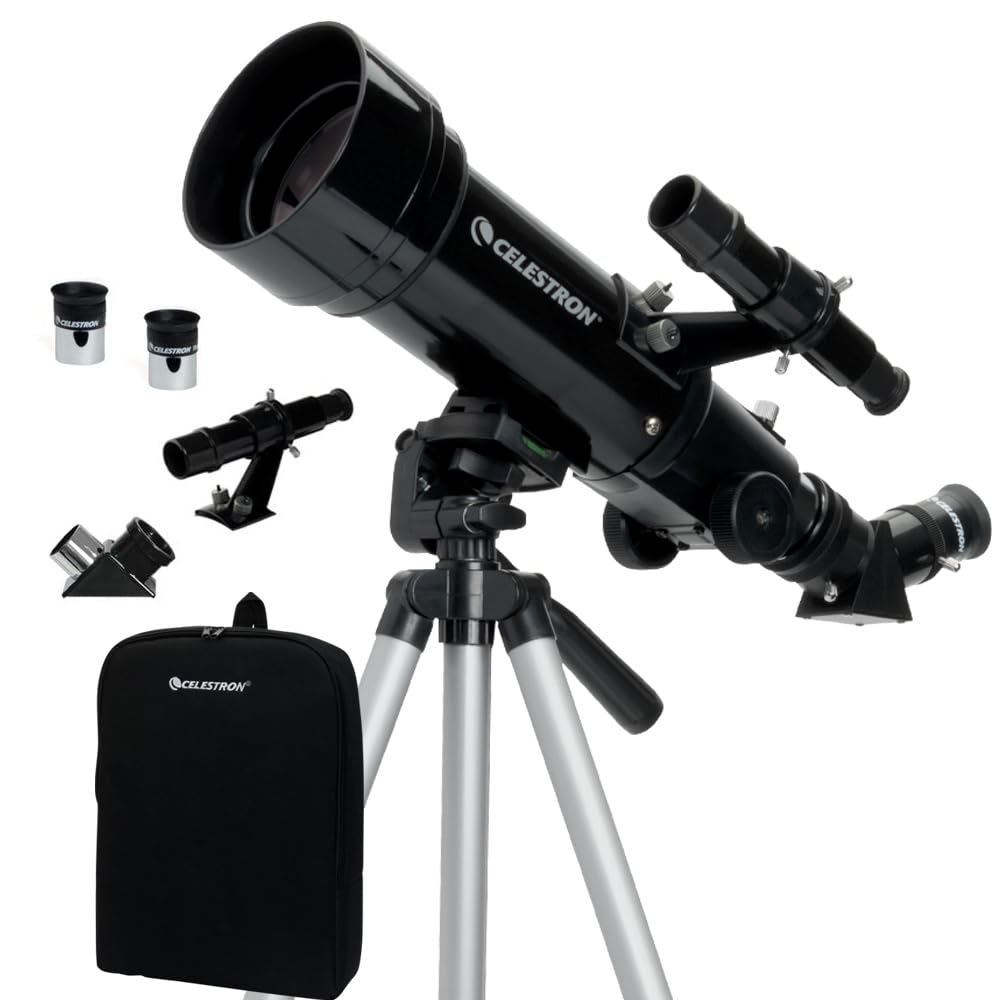
Celestron 21035 Travel Scope 70 Portable Refractor Telescope Kit with Backpack, Black
Our Recommendation
The Celestron 31042 AstroMaster 114EQ is the better buy for most people because its 114mm aperture delivers far more capable night-sky views than the 70mm Travel Scope. It is stronger on the Moon, planets, and brighter deep-sky objects, and the equatorial mount makes it a more serious tool for learning astronomy. Although it costs £160.04 more, that extra money buys a telescope you are far less likely to outgrow.
Detailed Comparison
Display
For telescopes, the closest equivalent to screen quality is the view at the eyepiece: brightness, sharpness, and how much detail you can actually see. Product A, the Celestron 31042 AstroMaster 114EQ Newtonian Reflector, wins here because its 114mm aperture gathers far more light than Product B’s 70mm refractor. That extra light makes a real difference on the Moon, Jupiter, Saturn, and brighter deep-sky objects, especially from typical UK suburban skies where light pollution can wash out faint targets. Product B can still deliver pleasing, crisp views of the Moon and terrestrial subjects, but it simply cannot compete with the larger reflector when it comes to pulling in detail.
Performance
Product A is the clear performance winner. A 114mm Newtonian reflector is a much stronger astronomical instrument than a 70mm travel refractor, and the difference is easy to see in practice: more lunar craters, better planetary detail, and a better chance of spotting open clusters, nebulae, and galaxies from a dark-sky site. The AstroMaster 114EQ also comes on an equatorial mount, which, once aligned, helps you follow objects across the sky more smoothly than a basic lightweight alt-az setup. Product B is fast to deploy and fine for casual observing, but its smaller aperture and travel-first design mean it is best thought of as a starter scope for the Moon, bright planets, and daytime use rather than a serious all-rounder.
Build quality and design
This is a more nuanced category. Product A feels like the more substantial astronomy package: a reflector optical tube paired with an EQ mount gives it a more traditional, capability-focused design. It is better suited to learning the sky and growing into the hobby. Product B wins on portability and convenience, though; the Travel Scope 70 is designed to pack down into its backpack and be carried easily on walks, holidays, or trips to a dark-sky site. In the UK, where clear nights can be precious, that portability is genuinely valuable. Still, for overall build and design as an observing platform, Product A wins because it is built to do more serious celestial work, while Product B is built to be easy to take anywhere.
Battery life
Neither telescope is battery-powered in the usual sense, so this category is mostly about setup effort and how long it takes before you are actually observing. Product B wins for practical “energy efficiency” because it is quicker and less demanding to use: set it down, aim it, and start looking. Product A takes more effort to set up and usually benefits from a bit of alignment and learning the equatorial mount, which can feel like a hurdle on a short, cold UK evening. If you want the least friction between deciding to go outside and seeing the sky, Product B is easier. If you are willing to invest a few extra minutes for far better views, Product A is worth it.
Price and value for money
Product B wins on price, and by a wide margin. At £89.95, the Travel Scope 70 is £160.04 cheaper than the £249.99 AstroMaster 114EQ. That makes Product B the safer choice for someone who wants to spend as little as possible, or who is unsure how often they’ll actually use a telescope. But value is not just about the lowest price; it is about what you get for your money. Product A offers much more telescope for the cost, and for anyone serious about astronomy, the extra aperture and better observing potential make the higher price easier to justify. In pure value-for-observing, Product A wins. In budget friendliness, Product B wins.
Game library/features
For telescopes, this translates to observing versatility and included kit. Product A wins because a 114mm reflector opens up a much broader “observing library”: more satisfying lunar detail, more capable planetary viewing, and a better shot at deep-sky objects under dark UK skies. The equatorial mount also adds a learning feature that helps users understand how the sky moves, which is a real bonus for beginners who want to progress. Product B’s main feature is its backpack and portability; it is convenient, but its feature set is much more limited in astronomical terms. If you want a telescope that can grow with you, Product A has the stronger feature set.
Overall user experience
Product B is the easier and more forgiving first experience. It is lighter, cheaper, and more likely to be used spontaneously, which matters when British weather gives you a narrow observing window. It is ideal for a family, a casual holiday scope, or someone who mainly wants Moon views and a bit of stargazing without fuss. Product A, however, delivers the experience that most people imagine when they say they want a telescope: a proper step into astronomy, with noticeably better views and more room to learn. Yes, it asks more of the user, but the reward is far greater. For UK observers dealing with light pollution, the bigger aperture of Product A is especially important, because it helps compensate for less-than-perfect skies.
Overall summary: if you want the better telescope, buy the AstroMaster 114EQ. If you want the easier, cheaper, more portable option, the Travel Scope 70 is fine — but it is a compromise scope. For most people who are genuinely choosing between these two as a first astronomy telescope, Product A is the stronger long-term buy and the one that will keep you looking up after the novelty wears off.
Buy the Celestron 31042 AstroMaster if...
Buy Product A if you want the best astronomical performance for the money and plan to observe the Moon, planets, and brighter deep-sky objects from UK skies. It is the better choice if you are willing to spend a bit more time setting up in exchange for much better views and a telescope that can grow with you. Choose it if this is your main scope rather than a travel accessory.
Buy the Celestron 21035 Travel if...
Buy Product B if your priority is portability, simplicity, and keeping costs low. It is a good fit if you want something easy to carry in the included backpack for holidays, car trips, or occasional casual observing. Choose it if you mainly want Moon views, daytime use, or a very lightweight first telescope with minimal fuss.
Curated by Star Seeker on All The Top Picks
As an Amazon Associate we earn from qualifying purchases.