MicroFreak or Messenger: affordable hybrid weirdness vs premium Moog muscle
If you’re choosing between the Arturia MicroFreak and the Moog Messenger, you’re really deciding between two very different synth philosophies. The MicroFreak is a compact 25-key hybrid instrument built for experimentation, sound design, and budget-conscious studios. The Messenger is a larger 32-key monophonic analog keyboard aimed at players who want classic Moog feel, immediate control, and a more premium performance instrument. This comparison is for musicians who care about how a synth plays, sounds, records, and fits into a real studio or live setup.

Arturia - MicroFreak Synthesizer Keyboard - 25-Key Hybrid Synth with PCB Keyboard, Wavetable & Digital Oscillators, Analog Filters Blue
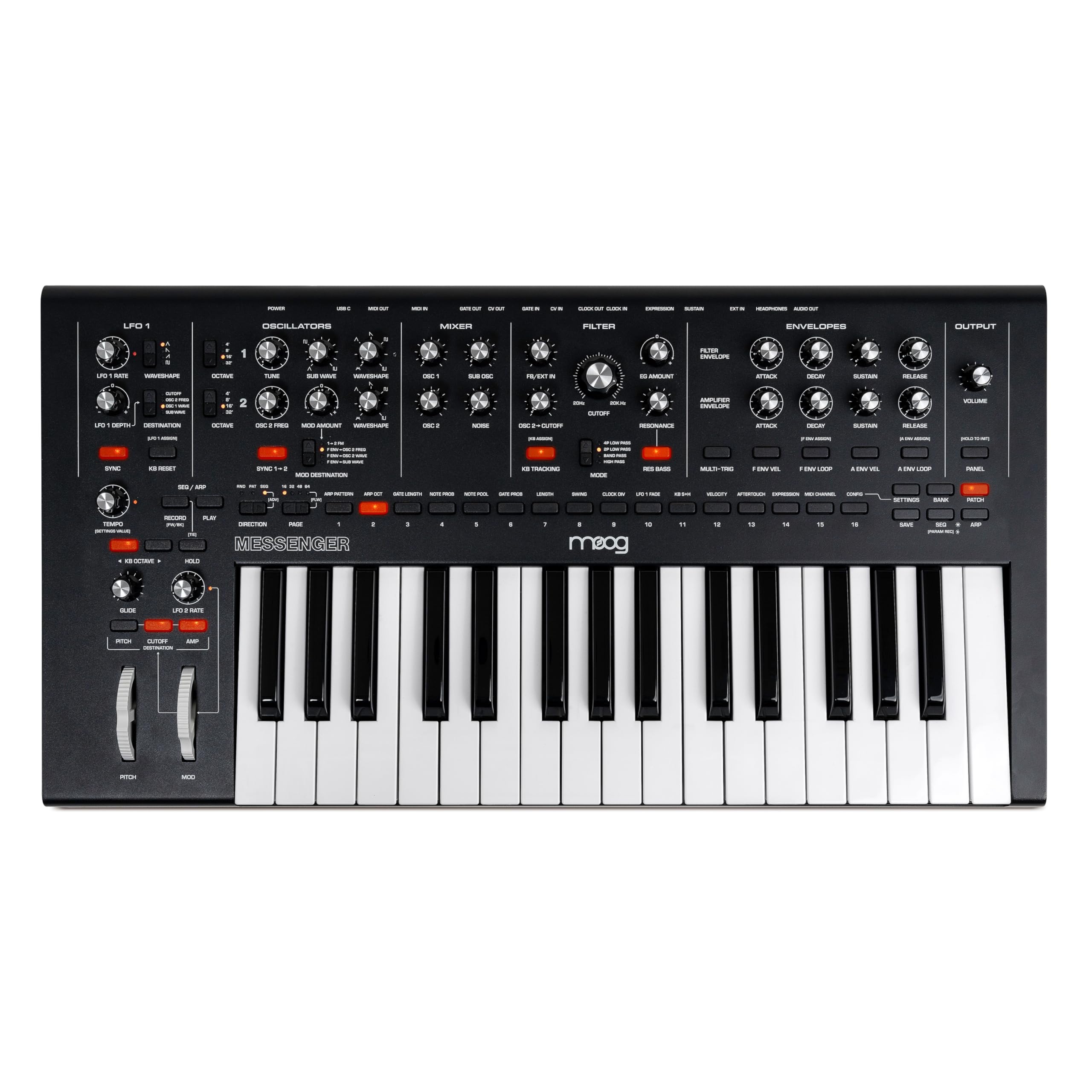
MOOG Messenger - Next-Gen Monophonic Analog Keyboard Synthesizer with 32 Keys, 64-Step Sequencer, 256 Presets and RES BASS Compensation
Our Recommendation
Buy the Arturia MicroFreak if you want the best balance of price, creativity, and versatility. At £255, it undercuts the Moog by £322 while offering wavetable and digital oscillators, an analog filter, and a highly experimental workflow. The Moog Messenger is excellent, but its premium cost only makes sense if you specifically want a 32-key, monophonic analog keyboard with classic Moog character.
Detailed Comparison
Display
Neither synth is really about a screen-first workflow, but the MicroFreak still wins here by virtue of its more modern hybrid control layout and deeper visual feedback for sound-shaping tasks. Its OLED-style interface and matrix-driven editing make wavetable and digital oscillator navigation more practical than on a purely analog board. The Messenger is more immediate and performance-led, but its display and on-panel feedback are secondary to knob-per-function control. Winner: Arturia MicroFreak, because it gives you more visible editing support for complex synthesis.
Performance
This is the closest thing to a split decision, but the Moog Messenger wins for pure playing and expression. It has 32 keys, giving you a larger range than the MicroFreak’s 25-key PCB keyboard, and it uses a proper keyboard format rather than Arturia’s touch-style capacitive approach. That makes it better for basslines, leads, and hands-on performance, especially if you’re coming from piano or synth-action instruments. The MicroFreak is excellent for sequencing, modulation, and unusual textures, but its keybed is intentionally unconventional and less satisfying for traditional keyboard technique. Winner: Moog Messenger, because the 32-key layout and conventional playing experience are better for serious performance.
Build quality and design
The Messenger wins here too. Moog has a strong reputation for sturdy, road-ready hardware, and the Messenger’s design is clearly aimed at players who want a premium analog instrument with tactile confidence. At £577, it is more than twice the price of the MicroFreak, but part of that cost is the more substantial feel and more performance-oriented layout. The MicroFreak is well loved, but its lightweight, experimental design and PCB keyboard are deliberately quirky rather than luxurious. Winner: Moog Messenger, for more robust build quality and a more professional hands-on feel.
Battery life
Neither product is meaningfully positioned as a battery-powered instrument, so this category is effectively a tie. In practice, both are mains-powered desktop/keyboard synths meant for studio or stage setups, not busking or mobile battery use. If portability matters, the MicroFreak is the easier one to move because it is smaller and lighter, but that is not the same as battery life. Winner: tie.
Price and value for money
This is where the MicroFreak dominates. At £255, it costs £322 less than the Messenger, and that is a massive gap in the UK market. For the money, you get a 25-key hybrid synth with wavetable and digital oscillators plus an analog filter, which is an unusually broad feature set at this price. The Messenger is more expensive but also more specialised: a monophonic analog Moog with 32 keys, 64-step sequencer, 256 presets, and RES bass compensation. If you want maximum sonic variety per pound, the MicroFreak is the clear value winner. Winner: Arturia MicroFreak, by a wide margin.
Game library/features
For synth buyers, this category maps to sound engine depth, presets, sequencing, and connectivity. The MicroFreak wins on sheer sonic flexibility: hybrid synthesis, wavetable and digital oscillators, and an analog filter make it far more adventurous for sound design than a straightforward monophonic analog synth. The Messenger counters with more traditional strengths: 64-step sequencer, 256 presets, and Moog’s signature bass compensation and analog tone. If you want one keyboard that covers a huge range of experimental sounds, the MicroFreak is more expansive. If you want a focused analog instrument with strong preset recall and a sequencer built for musical lines, the Messenger is stronger in workflow. Overall winner: Arturia MicroFreak for breadth; Moog Messenger for focused analog features.
Overall user experience
The MicroFreak is the better choice for curious producers, electronic musicians, and anyone who wants an affordable synth that encourages experimentation. Its 25-key layout and PCB keyboard can feel unconventional, but that same oddness is part of its appeal: it invites sound design rather than traditional piano-style playing. The Messenger is the better choice for players who want a premium, immediate, and expressive monophonic analog keyboard with a more conventional playing surface and a stronger sense of instrument quality. Its 32 keys, 64-step sequencer, and 256 presets make it feel like a serious performance tool, but you pay heavily for that refinement. Overall summary: the MicroFreak is the smarter buy for most people because it offers more sound-shaping power and far better value; the Messenger is the premium pick if you specifically want Moog’s analog character and a more traditional keyboard experience.
Overall winner: Arturia MicroFreak. It is dramatically cheaper, more versatile, and better value for most musicians, especially producers and sound designers. The Moog Messenger is the better instrument if your priority is a premium monophonic analog keyboard with a larger key range and classic Moog feel, but it is harder to justify at more than double the price unless that specific experience is what you want.
Buy the Arturia - MicroFreak if...
Buy Product A if you are a producer, synth explorer, or home-studio musician who wants maximum sound design potential for the least money. Its 25-key hybrid layout, digital oscillator options, and analog filtering make it ideal for experimental textures, sequencing, and learning synthesis. It is also the better choice if you want a compact instrument that leaves budget for other gear.
Buy the MOOG Messenger - if...
Buy Product B if you are a keyboard player who values a more traditional playing feel and wants a premium analog instrument with Moog pedigree. The 32 keys, 64-step sequencer, and 256 presets make it more immediately performance-ready, especially for bass and lead parts. Choose it if you are willing to pay extra for build quality, tactile control, and classic monophonic analog tone.
Curated by Keys & Strings on All The Top Picks
As an Amazon Associate we earn from qualifying purchases.