Big-Value Resin Showdown: 2kg Grey Standard vs 1kg ABS-Like Pro 2
If you’re choosing between these two ANYCUBIC resins, you’re really deciding between sheer value and material performance. Product A gives you a huge 2kg bottle of standard grey resin for almost the same money as Product B’s 1kg bottle of ABS-like clear resin. Product B, though, is aimed at makers who want tougher, more impact-resistant parts with a bit more confidence in functional prints. This comparison is for anyone printing minis, prototypes, or practical parts and wanting the clearest possible buy recommendation.
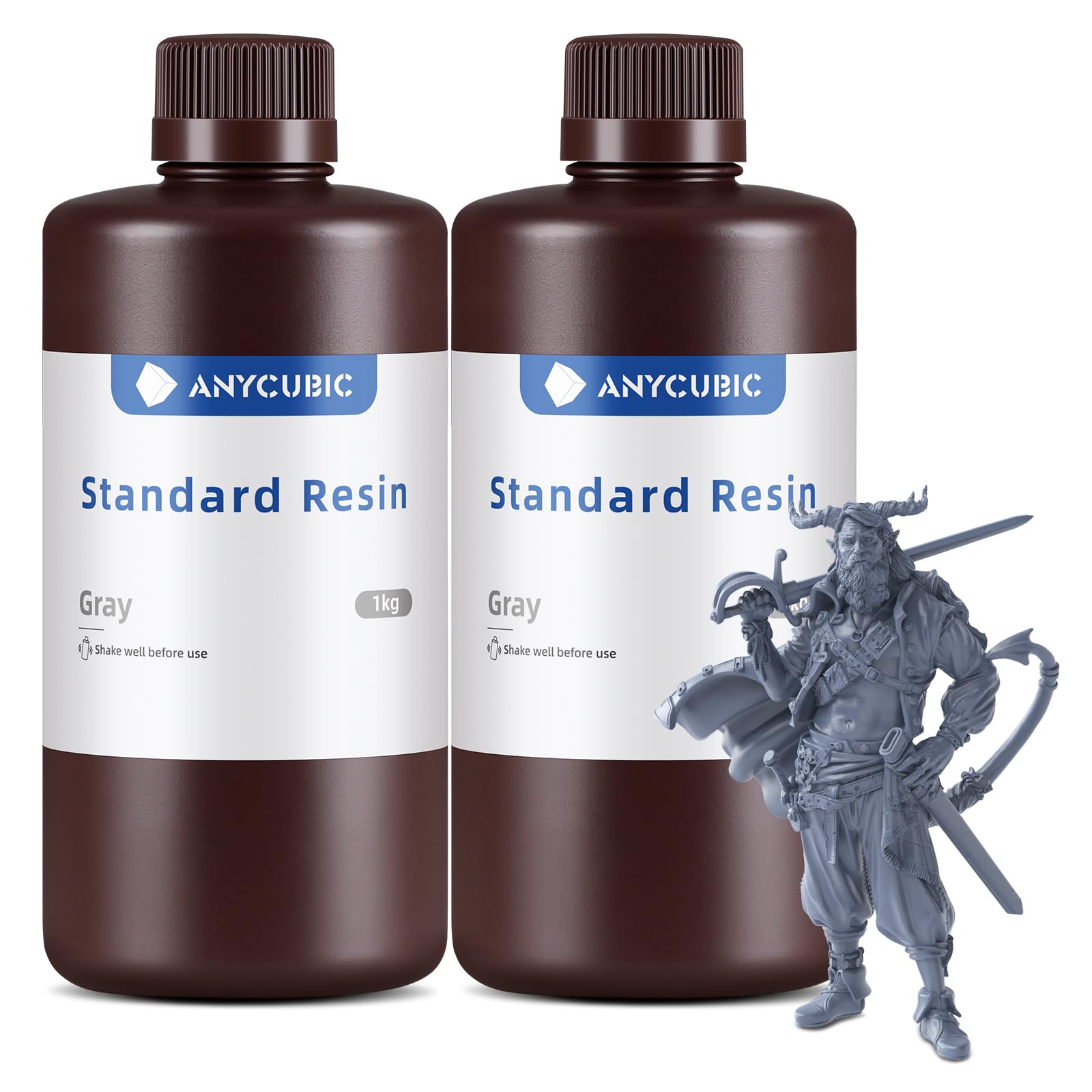
ANYCUBIC 3D Printer Resin 2KG, Standard 405nm UV Fast Curing Photopolymer Resin with High Precision and Low Shrinkage for 8K/14K LCD Resin 3D Printer, Grey

ANYCUBIC ABS-Like Resin Pro 2, 3D Printer Resin with Enhanced Strength and Toughness, High Precision and Minimal Shrinkage 3D Resin, Widely Compatible with All Resin 3D Printers(Clear,1kg)
Our Recommendation
Product A is the better buy for most people because it gives you 2kg of resin for £23.98, versus just 1kg of Product B for £23.99. It also has the stronger review score at 4.7/5 from 1,461 ratings, which is a good sign of consistent real-world performance. Unless you specifically need the extra toughness of ABS-like resin, Product A is the smarter, better-value choice.
Detailed Comparison
Display / Finish Quality
Winner: Product A
For visual output, Product A’s grey standard resin is the safer all-round choice for most resin printers, especially if you’re printing miniatures, display models, or parts where you want crisp surface detail and easy post-processing. Grey resin is a maker favourite because it shows layer lines, edges, and sculpted detail clearly without the distraction of transparency. Product B is clear, which can look great for special applications, but clear resins are usually less forgiving when you want to inspect surface flaws, and they often need more work to achieve a clean aesthetic finish. If your priority is “looks good straight off the plate,” Product A wins.
Performance
Winner: Product B
Product B is the stronger performer when the print needs to do more than just look good. ABS-like resin is formulated for enhanced strength and toughness, which usually translates to less brittleness and better resistance to cracking during handling, sanding, or light functional use. Product A’s standard resin is designed for high precision and low shrinkage, so it’s excellent for accurate detail, but standard resins are generally more brittle than ABS-like blends. If you’re printing clips, small housings, mechanical test parts, or anything that might get handled a lot, Product B has the edge.
Build Quality and Design
Winner: Product B
This category is really about material engineering rather than the bottle itself. Product A is a standard 405nm UV fast-curing photopolymer with a focus on precision and low shrinkage, which makes it a dependable general-purpose resin. Product B’s ABS-like formulation is the more advanced material, because it is specifically tuned for strength and toughness while still promising high precision and minimal shrinkage. In practical maker terms, that means Product B is better suited to parts that need a bit of flex and durability, while Product A is better for clean, accurate, everyday printing. For design intent and material robustness, Product B wins.
Battery Life / Curing Efficiency
Winner: Product A
Since these are resins rather than battery-powered devices, the relevant comparison is curing efficiency and workflow speed. Product A is explicitly marketed as fast curing, which can make it a little more convenient in day-to-day printing and help keep exposure times sensible on 8K/14K LCD printers. Product B does not emphasise fast curing in the same way, so while it should still print well, Product A has the more straightforward “plug in and get on with it” appeal. If you value a resin that’s geared towards quick, reliable throughput, Product A takes this round.
Price and Value for Money
Winner: Product A
This is the clearest win in the whole comparison. Product A costs £23.98 for 2kg, while Product B costs £23.99 for 1kg. That means Product A is not just cheaper by £0.01, it is dramatically better value on a per-gram basis: you get double the material for effectively the same money. If you’re printing often, testing settings, or just don’t want to keep reordering resin, Product A is the obvious value champion. Even if Product B is the better specialty material, the price gap is so tiny that the real difference is volume, and Product A dominates there.
Game Library / Features
Winner: Product B
Translating this category into resin-printer terms, the “features” are compatibility, versatility, and what kinds of projects each resin suits. Product B is the more specialised and versatile material in a functional sense, because ABS-like resins are better for wider use cases where toughness matters. It is also marketed as widely compatible with all resin 3D printers, which is reassuring if you use multiple machines or plan to switch printers later. Product A is also compatible with 8K/14K LCD resin printers, but it is more clearly positioned as a standard general-purpose resin rather than a performance-focused one. For makers who want more material capability, Product B wins.
Overall User Experience
Winner: Product A
For most people, Product A will feel like the easier, more satisfying buy. It has the stronger rating at 4.7/5 from 1,461 reviews, compared with Product B’s 4.5/5 from 968 reviews, which suggests slightly broader buyer satisfaction and confidence. Add in the huge 2kg bottle, the low-shrinkage standard formula, and the excellent grey finish for seeing detail, and Product A becomes the better everyday resin for the majority of users. Product B is still a very good resin, but it is more targeted: better if you specifically need toughness and ABS-like behaviour, not just general printing.
Overall summary: Product A is the definitive winner for most buyers because it offers far better value, more material, a higher rating, and excellent all-round print quality. Product B only becomes the better choice if your main priority is durability and toughness over volume and cost efficiency. If you want the safest recommendation, buy Product A. If you want a tougher resin for functional parts, buy Product B.
Buy the ANYCUBIC 3D Printer if...
Buy Product A if you want the best value for money and print a lot of minis, display models, or general-purpose parts. It’s also the better choice if you want a clean grey finish that makes details easy to see and post-process. If you’re not sure which resin to choose, Product A is the safer default.
Buy the ANYCUBIC ABS-Like Resin if...
Buy Product B if your prints need to survive handling, light flexing, or occasional knocks and you care more about toughness than bulk volume. It’s a better pick for functional parts, clips, small enclosures, or anything that benefits from ABS-like behaviour. Choose it if you specifically want a stronger, less brittle resin and don’t mind paying the same price for half the quantity.
Curated by The Print Lab on All The Top Picks
As an Amazon Associate we earn from qualifying purchases.